
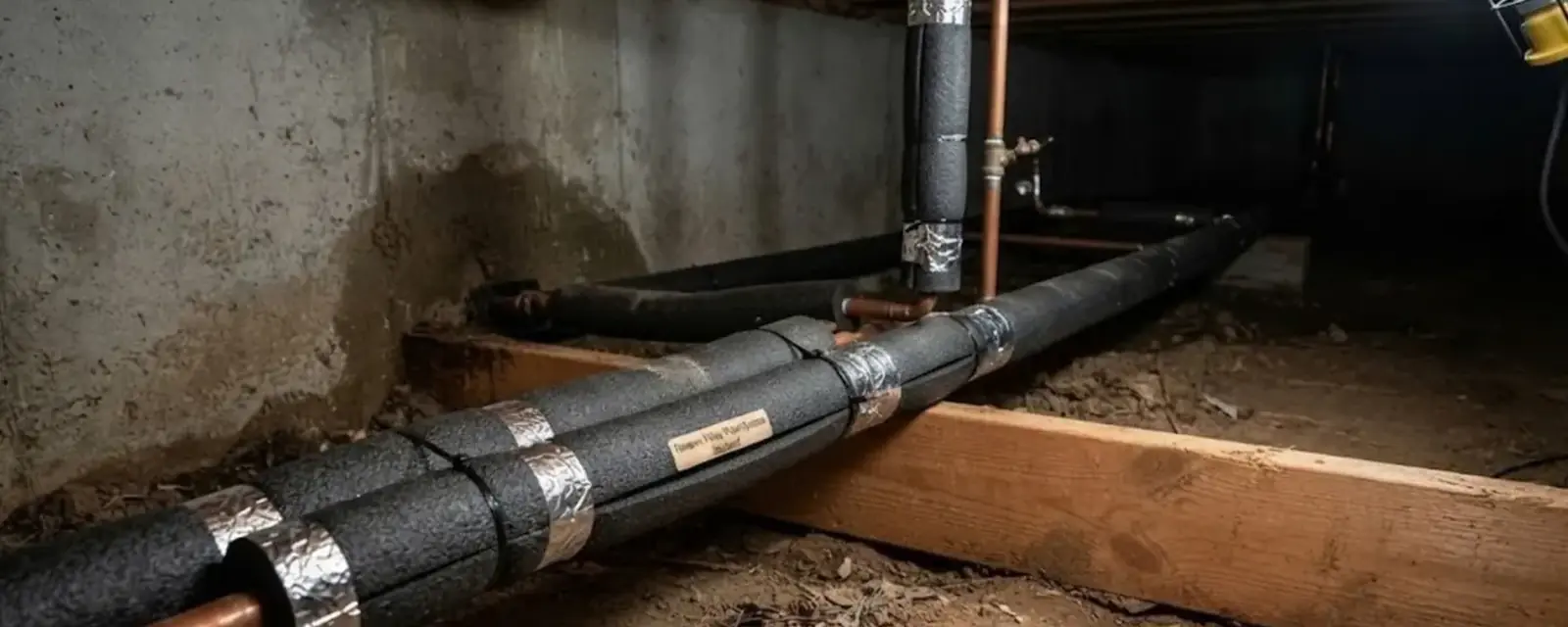
Pipes freeze when a cold snap meets a pipe in an unheated space with moving air around it. The split often shows up only after the thaw, when water floods through.
Lake cottages and homes left empty for weeks are the most exposed, because no one is there to notice the cold.
Where pipes freeze first
Crawl spaces, exterior walls, garages, outdoor spigots and pipes near vents or drafts are the usual places. A pipe on an exterior wall with little insulation behind it is a classic case.
Kitchens and bathrooms with sinks on exterior walls need attention. Cabinet doors can be opened on cold nights to let warm air in.
Before the cold arrives
A short list for any house going into winter.
Disconnect and drain outdoors
Remove hoses, close indoor shutoffs to outdoor spigots and drain them.
Insulate exposed lines
Foam sleeves on pipes in crawl spaces, garages and exterior walls.
Seal the drafts
Close gaps near pipes where cold air enters.
Know your main shutoff
Locate it and test it before you need it in an emergency.
Occupied versus empty homes
The right steps depend on whether someone is there.
| Situation | Best approach |
|---|---|
| Occupied home, cold snap | Keep heat on, let a faucet drip, open cabinet doors |
| Empty for a few days | Keep heat at a safe setting and have someone check |
| Seasonal cottage closed for the winter | Full winterizing: drain the system, protect the heater and traps |
| Power outage in winter | Open faucets slightly and consider draining pipes |
Winterizing a seasonal home
Shut off the main, open faucets to drain the lines, drain the water heater and add non-toxic plumbing antifreeze to traps, according to a plumber's instructions. On a well, shut off the pump breaker and drain the pressure tank and lines.
A full winterizing is best done by a licensed plumber, and a plumber can recharge the system in spring and check for leaks.
If a pipe freezes
Shut off the water at the main, open the nearest faucet and warm the pipe slowly with a hair dryer or warm towels. Never use an open flame. Check along the pipe for splits and look for leaks as it thaws.
If water appears, shut off the main and call our emergency burst pipe repair line.
Checking an empty house
If you leave a house for days, ask someone to check it, or install a temperature sensor that alerts your phone. A lapse in heat can freeze pipes within hours of a deep freeze.
For seasonal homes, shut off water at the main and drain the system rather than relying on heat.
Spring start-up
When you reopen a cottage, open the main slowly and check each fixture, the water heater and the pressure tank for leaks. A small leak from a pipe that froze can be silent until pressure returns.
A plumber can pressure test the system and recharge the heater safely.
A fall walkthrough list
Walk the house with a flashlight and check the crawl space, the garage, the exterior walls and the cabinets under sinks on outside walls. Look for gaps near pipes and for pipes without insulation.
Fix what you find before the first hard freeze, since a cold night is a poor time to start.
Insulation choices
Foam sleeves are inexpensive and easy to fit on straight runs. Fiberglass wrap suits odd shapes but must stay dry. Heat cable adds protection for pipes that cannot be insulated well.
No insulation stops freezing in a space with no heat, so insulation slows heat loss but does not replace warmth.
Insurance and frozen pipes
Many policies cover sudden water damage from a burst pipe but may limit coverage for vacant or unheated homes. Read the vacancy and heat requirements in your policy before leaving a home empty for the winter.
Ask your agent what steps they expect you to take, and keep a record that you took them.
Checking after a cold snap
After a hard freeze, open each faucet and check for a drop in flow. Look under sinks and in the crawl space for drips and frost. A pipe that froze may have split without leaking until the thaw.
If you see any sign of a split, shut off the main and call a plumber before the line thaws fully.
Local notes for West Milford
Cold and seasonal housing define the risk.
Long winters
West Milford sits in the Highlands, and about 51 inches of precipitation a year includes plenty of winter weather.
Lake communities
Greenwood Lake covers about 1,920 acres shared with New York, and the lake areas include many seasonal and converted cottages.
Well systems
With 2,449 domestic wells recorded in the township study, many homes also have a pump and pressure tank to protect.
Heating fuel
Many properties use propane, so a fuel delivery lapse can leave a house cold, so keep tanks filled.
Cottages around Ringwood's Cupsaw Lake and Erskine Lakes face the same issues. See our Ringwood and Bloomingdale pages for local notes.
Frozen pipe questions
What temperature should I leave the heat at?
A setting that keeps the interior well above freezing, as a plumber or your insurer advises.
Should I let faucets drip?
In a hard freeze, a slow drip on the most exposed line can help.
Is heat tape safe?
Use a product rated for plumbing and follow its instructions.
How do I know if a pipe split?
Water appears when it thaws, or pressure drops.
Can a plumber winterize my cottage?
Yes, and spring start-up too.
Can a frozen pipe thaw on its own?
It can, but a split pipe will then leak. Check carefully and shut off the water if you find damage.
Is winterizing covered by a standard?
Winterizing follows the manufacturer's instructions for each appliance, and any new piping follows the National Standard Plumbing Code that New Jersey adopts in N.J.A.C. 5:23-3.15.