
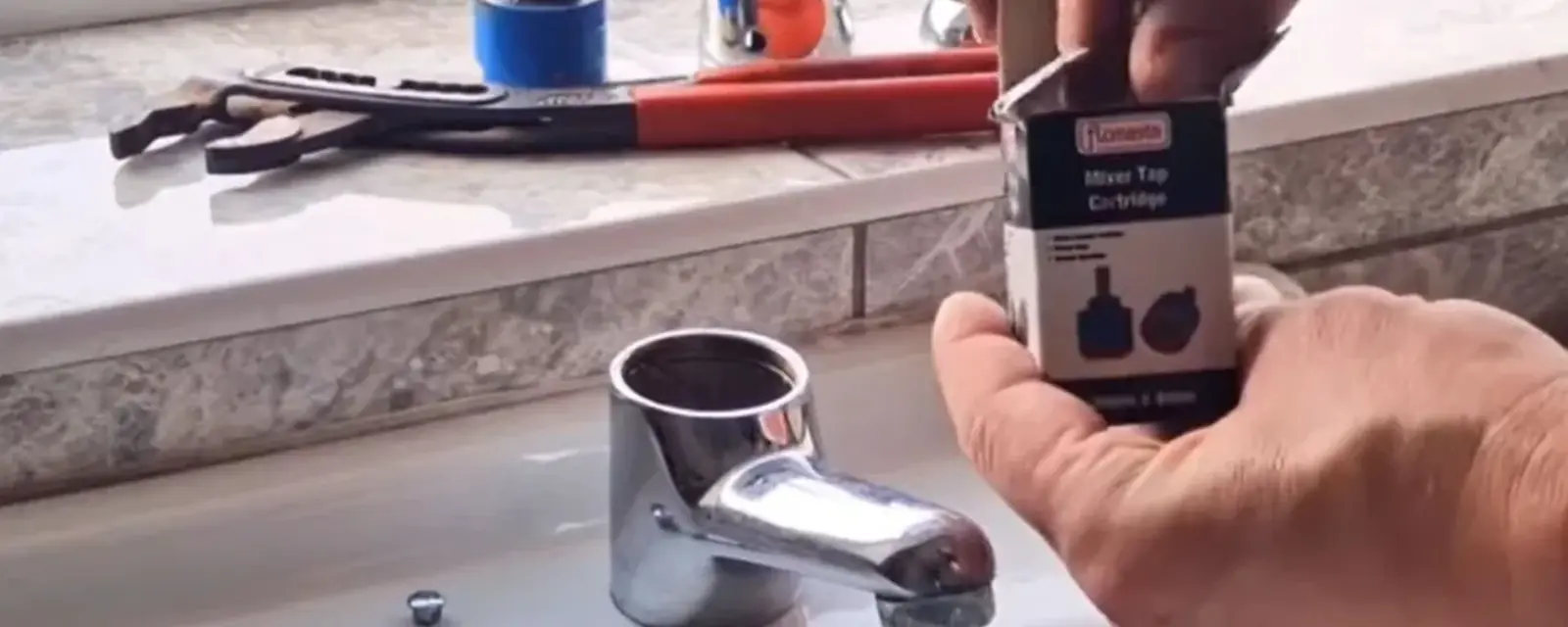
A kitchen faucet handle gets pushed and pulled dozens of times a day, so it is no surprise that it loosens, stiffens or starts to leak around the base. Most of these problems come from a few small parts.
This guide explains how to tell which part has failed, what a careful repair looks like and when it is cheaper to replace the whole faucet.
Loose or wobbly handle
A handle that wobbles usually has a loose set screw or a worn retaining nut. The set screw sits under a small cap or on the side of the handle. Lift off the cap, tighten the screw with the right hex key and check that the handle sits firmly on the stem.
If the screw keeps loosening, the stem or the handle bore is worn. At that point a new handle or a new cartridge is the lasting fix.
Stiff handle or hard to turn
Mineral buildup inside the cartridge is the usual cause of a stiff handle. Turn off the water at the stop valves under the sink, remove the handle and retaining nut and pull the cartridge. Soak it in vinegar and look at the O-rings.
Hardened or flattened O-rings leak and drag. A cartridge that is scored or scaled should be replaced, not cleaned again.
Symptom and likely fix
A quick guide to the common handle problems.
| Symptom | Likely cause | Typical fix |
|---|---|---|
| Handle wobbles | Loose set screw or nut | Tighten, or replace worn parts |
| Handle is stiff | Mineral scale in the cartridge | Clean or replace cartridge |
| Drip from the spout | Worn cartridge or seat | Replace cartridge or seats and springs |
| Leak at the handle base | Worn O-ring | Replace O-rings |
| Water under the sink | Supply line or connection | See emergency faucet repair |
Leak at the base of the handle
Water that rises around the base of the handle comes up past a worn O-ring or a loose packing nut. Replacing the O-rings is a fifteen minute job once the cartridge is out, and a bit of plumber's grease on the new rings helps them seal.
A leak that appears only when the water is on and goes away when you shut it off is almost always one of these two parts.
Know your brand before you shop
Many cartridges are brand specific. Take the old cartridge to the store, or note the faucet's brand and model from a stamp on the body, the underside of the sink or the original box. A cartridge that is nearly the same often leaks or does not fit.
If the manufacturer's parts are discontinued or cost more than a similar new faucet, replace the faucet and use the repair time to renew the supply lines.
Prevent repeat repairs
Wipe the faucet dry after use to limit scale, clean the aerator every few months and avoid forcing a stiff handle. A little vinegar on a cloth removes light scale around the base.
If hard water is a constant problem, a softener or filter protects every fixture in the house.
Quick safety and cleanup notes
Close the stop valves before taking anything apart and open the faucet to release pressure. Plug the sink drain so a small screw cannot fall into it.
Keep the old parts in a labeled bag. If a new part does not fit, the old one is the best guide for finding the right replacement.
Single-handle versus two-handle faucets
A single-handle faucet uses one cartridge to control both flow and temperature. A two-handle faucet uses a valve for each side, so a leak usually points to the washer or seat of one valve.
Knowing which kind you have helps you order the right part.
Local notes for West Milford
Water quality drives how often handle parts wear.
Hard municipal water
The Borough of Ringwood lists hardness up to 191 parts per million in its 2024 water quality report, and hard water leaves scale inside cartridges.
Soft but acidic water
Bloomingdale reports water with hardness near 36 parts per million and a pH of about 6.86, which scales less but can be hard on metal parts over time.
Private wells
The township groundwater study recorded 2,449 domestic wells, and well water can carry iron and sediment that stain and clog aerators.
Test your tap
If you are unsure what your water carries, test your tap or ask your utility for its latest report.
We repair faucets for homes in Ringwood and Bloomingdale, and the steps are the same.
When to call a plumber
Call if the stop valves will not turn, the cabinet is wet or the faucet is spraying. Shut off the main and use the emergency faucet repair line if water is out of control.
Also call if you are replacing the faucet and the old supply lines or valves are corroded, since forcing them can cause a leak inside the wall.
Faucet handle questions
How do I stop a kitchen faucet handle from loosening?
Tighten the set screw, replace worn parts and avoid hanging weight on the handle.
Can I fix a leaking faucet myself?
Often yes, with the water off and the right parts. Call a plumber if valves will not close.
Why does my faucet handle feel gritty?
Scale or sediment inside the cartridge. Clean or replace it.
What does a cartridge replacement include?
Shutting off water, removing the handle, swapping the cartridge and testing for leaks.
Is it worth repairing an old faucet?
If it is solid and parts are available, yes. If the body is corroded, replace it.
Do faucet parts have to meet a standard?
Fixtures sold for drinking water are certified to national standards, and installation follows the National Standard Plumbing Code that New Jersey adopts in N.J.A.C. 5:23-3.15.