
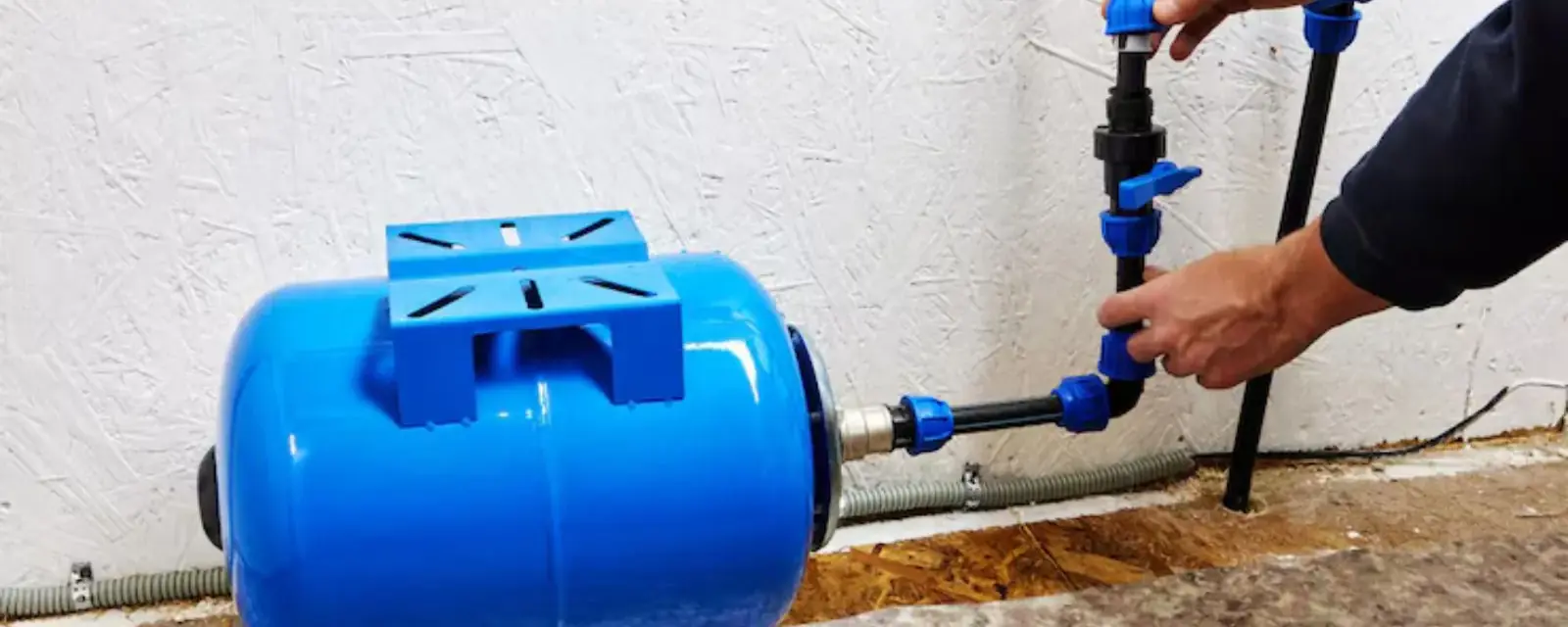
On a municipal system, pressure comes from the utility. On a private well, your own equipment creates it, so a drop in pressure can come from several parts.
Working from the tank outward is the quickest way to find the cause.
How a well system makes pressure
A pump pushes water from the well into a pressure tank. The tank holds an air cushion, and when pressure falls to the cut-in setting a switch turns the pump on. When pressure reaches the cut-out setting, the pump shuts off.
A typical range is 40 to 60 pounds per square inch, though systems vary. The gauge near the tank shows where yours stands.
Common causes of low pressure
Check these in order.
| Cause | Clue | Next step |
|---|---|---|
| Waterlogged pressure tank | Pump short-cycles, gauge swings fast | Check air charge, replace tank if needed |
| Pressure switch set low or failing | Pressure never reaches normal | Adjust or replace the switch |
| Clogged filter or iron buildup | Pressure low only after the filter | Change the filter |
| Leak in the line | Pump runs often, soggy spots | See leak detection |
| Failing pump | Weak flow, noise or no start | Pump test and repair |
Well yield and the seasons
Not every drop in pressure is equipment. A well with low yield may run low in dry spells, and the pump can pull air.
A well can also lose capacity over time as sediment or mineral deposits narrow the water-bearing fractures. A well professional can test yield.
Check the simple things
Look at the gauge and the tank's air valve, change any whole-house filter, and see whether pressure is low everywhere or at one fixture. If one fixture is low, the problem is local, such as a clogged aerator.
If every fixture is low, work back to the tank. If the pump runs constantly with low pressure, shut it off to avoid burning it out and call.
Protect the pump
A pump that runs dry or cycles rapidly overheats. If you hear it clicking on and off quickly, or running without building pressure, turn off its breaker and call for help.
Replacing a failed pressure switch is much less costly than replacing a burned-out pump.
Pressure tanks in plain language
A tank has a rubber bladder or diaphragm separating air from water. When the bladder fails, the tank fills with water and loses its cushion, so the pump cycles rapidly.
Checking the air charge with a gauge, with the pump off and the tank drained, tells you whether the tank is the problem.
Water quality and pressure
Iron and sediment clog screens and filters. A whole-house filter that has not been changed can cut pressure sharply.
If you suspect water quality, test it and talk to a water treatment professional.
Safe checks before you call
Look at the pressure gauge with water off and then with a tap running. Check the breaker for the pump and the filter housing for a dirty cartridge. Note any noises from the pump.
Do not adjust the pressure switch screws unless you know the settings, because a wrong setting can damage the pump.
Pressure regulators and old pipe
A pressure reducing valve is sometimes added to a well system. A failing one drops pressure for the whole house. Old galvanized pipe also narrows with corrosion, which reduces flow even when the system pressure is fine.
A plumber measures pressure at several points to tell the difference.
Why a quick fix can backfire
Raising the pressure switch settings to get more pressure can overwork the pump and strain old pipes and fittings. It can also make a hidden leak worse.
Find the cause first. A pressure number is a symptom, and the cure depends on what is behind it.
Seasonal changes in a private well
Water levels in bedrock wells rise and fall through the year. After a dry summer, a well with modest yield may deliver less water, and the pump can draw in air, which shows up as sputtering taps.
If sputtering comes and goes with the weather, tell the plumber. It helps separate a yield problem from an equipment problem.
Local notes for West Milford
Local wells have particular traits.
Many private wells
The 2003 township groundwater study recorded 2,449 domestic wells, and groundwater is the primary drinking water source.
Depth and yield
The median domestic well depth is 163 feet in Precambrian rock, with a median yield of 7 gallons per minute.
Aquifer rating
NJDEP ranks the bedrock aquifers in the township as very poor, so yield can be modest.
Test your water
If you suspect sediment or iron, test your water and ask a well professional about options.
Well questions are common in Ringwood and the outlying parts of West Milford. Homes in Kinnelon are served by a municipal water department, so pressure problems there may start with the utility rather than a well pump.
When to call the plumber
Call when the pump short-cycles, the switch fails or you suspect a line leak. For a broken buried line, see water service line repair.
Well pressure questions
What pressure should my well system have?
Many systems run in a range such as 40 to 60 pounds per square inch, but check your own settings.
Why does my pump click on and off?
A waterlogged tank or leak is a common cause.
Can sediment lower pressure?
Yes, by clogging filters and aerators.
Do I need a new tank?
Only if the bladder has failed or the tank is waterlogged.
Who tests well yield?
A well professional, not a general plumber.
Why do my taps sputter?
Air in the line from a low well level, a failing pump or a leak on the suction side can cause it.
What rules cover well equipment?
The township code has a chapter on water supply systems, including private wells, and the plumbing follows the National Standard Plumbing Code adopted in N.J.A.C. 5:23-3.15.