
Sewage in a basement or a toilet that will not clear anywhere in the house means the main sewer line may be broken or blocked. Call our 24/7 line, stop all water use and keep people and pets away from the affected area until the plumber arrives.
A line that is blocked can be cleared. A line that is cracked, offset or collapsed has to be repaired, and the difference is only visible with a camera. That is why the first visit focuses on finding what is actually wrong rather than quoting a dig.
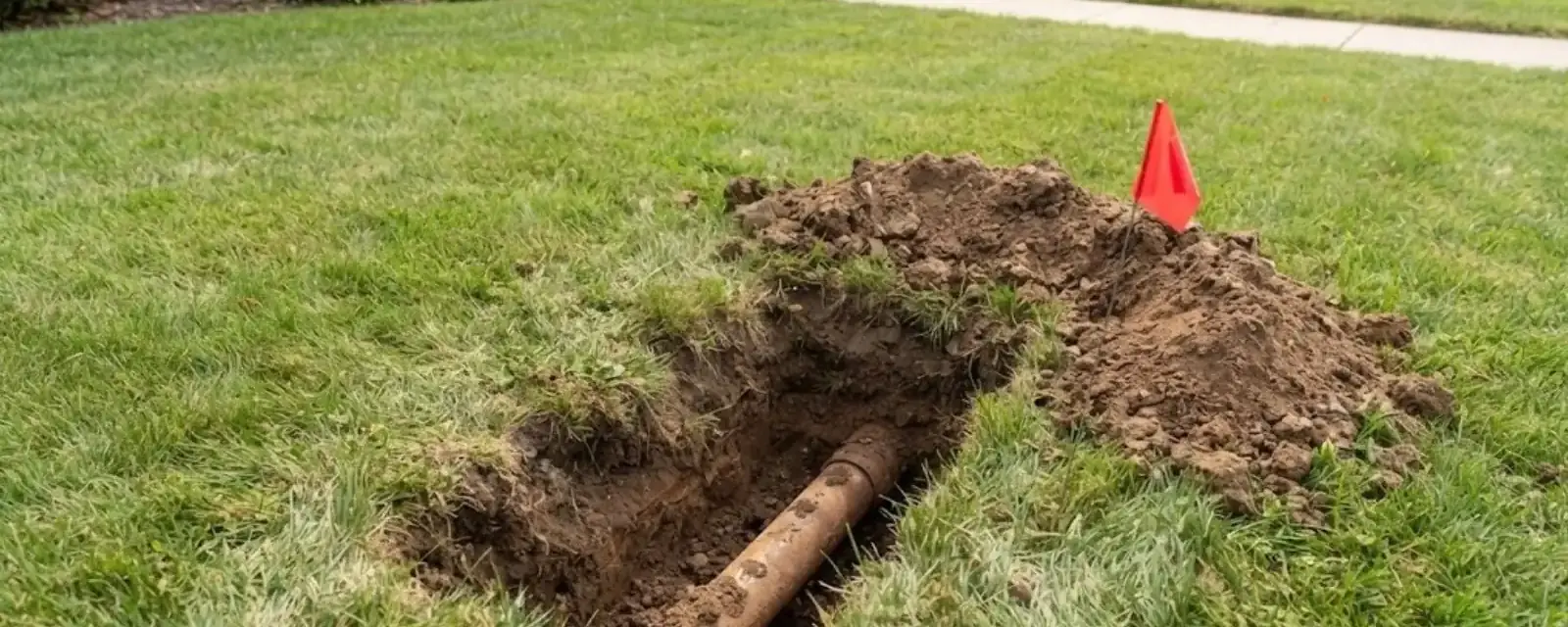
Before any excavation in New Jersey, the law calls for a free utility mark-out through NJ One Call at 811, with at least three full business days of notice, so a repair that needs a trench has a built-in planning step.
Emergency first steps: from symptom to diagnosis
The plumber runs a camera through the cleanout and records the pipe condition, the depth and distance to any defect and the pipe material. Cracks, root intrusion, bellied sections that hold water and separated joints each look different on screen.
That recording becomes the basis for the repair plan, and you can see exactly what the plumber sees before you approve anything.
Repair options for different defects
Which repair fits depends on the defect and the site.
| Defect | Common repair | Trade-off |
|---|---|---|
| Short crack or broken joint | Spot repair with excavation | Digs one section, fastest for a single defect |
| Long run of aging pipe | Lining with a new inner pipe | Less digging, needs a cleaned pipe and the right diameter |
| Collapsed or heavily offset pipe | Excavate and replace the section | Most reliable, most disruption to the yard |
| Roots through joints | Cut roots, then repair joints | Roots return if the joint is not sealed |
Sewage backing up?
Call the 24/7 line. We will tell you what to shut off and when a plumber can be on site.
Trenchless or traditional
Trenchless lining and pipe bursting avoid a long trench, which matters in yards with mature trees, patios or septic components close to the line. They are not available for every failure, and the camera decides whether the pipe can take a liner.
When the line has collapsed or the slope is wrong, digging is the honest answer. A cleaned, accurate camera map lets the plumber cut as narrow a trench as the job allows. If the real problem turns out to be a blockage, sewer line cleaning may be all you need.
Septic homes are a separate question
The township's groundwater study notes that a large share of local soils have severe limits for conventional septic, so many properties here have systems of unusual design. If your home is on septic, the pipe between the house and the tank is a sewer line, but the tank and field are a different job, and the plumber will tell you where the line you are paying for ends.
What shapes the price of a sewer repair
Sewer repair quotes vary widely because every yard is different.
Depth and length of the defect
A shallow, short break costs less to reach than a deep one under a driveway.
Repair method
Spot repair, lining and full replacement are different scopes.
Surface restoration
Lawn, paving and landscaping around the trench are part of the plan.
Permits and mark-out
Digging calls for a utility mark-out and may call for permits.
Time of the call
An emergency visit to stop a backup is priced differently than a scheduled repair.
Insurance may cover sudden damage from a backup but usually not the aging pipe itself, so check your policy for sewer backup coverage. You get a clear price before work starts, and the real number comes from one call.
Sewer line repair questions
Do you handle sewer line repair emergencies at night or on weekends in West Milford?
Yes. A sewage backup is an emergency, and the 24/7 line takes calls nights, weekends and holidays. Stop water use and keep clear of the affected area while you wait.
How do I know if my sewer line is broken?
Multiple fixtures backing up, sewage smell, soggy ground over the line and repeat clogs after cabling are common signs. A camera inspection confirms it.
Do I have to dig up the whole yard?
Often not. A camera locates the defect so the trench can be short, and some defects can be lined without a trench.
Who is responsible for the sewer line?
In general the owner is responsible for the lateral from the house to the connection point. The plumber can tell you where your line ends.
Can roots really break a sewer pipe?
Roots enter through small cracks and joints and widen them. They rarely break sound pipe on their own.
What does the repair warranty cover?
Ask the plumber for the details in writing before work starts, since coverage depends on the repair type.
What rules govern a sewer repair?
Sewer work follows the state plumbing subcode, which adopts the National Standard Plumbing Code under N.J.A.C. 5:23-3.15, and digging calls for a utility mark-out through NJ One Call at 811.