
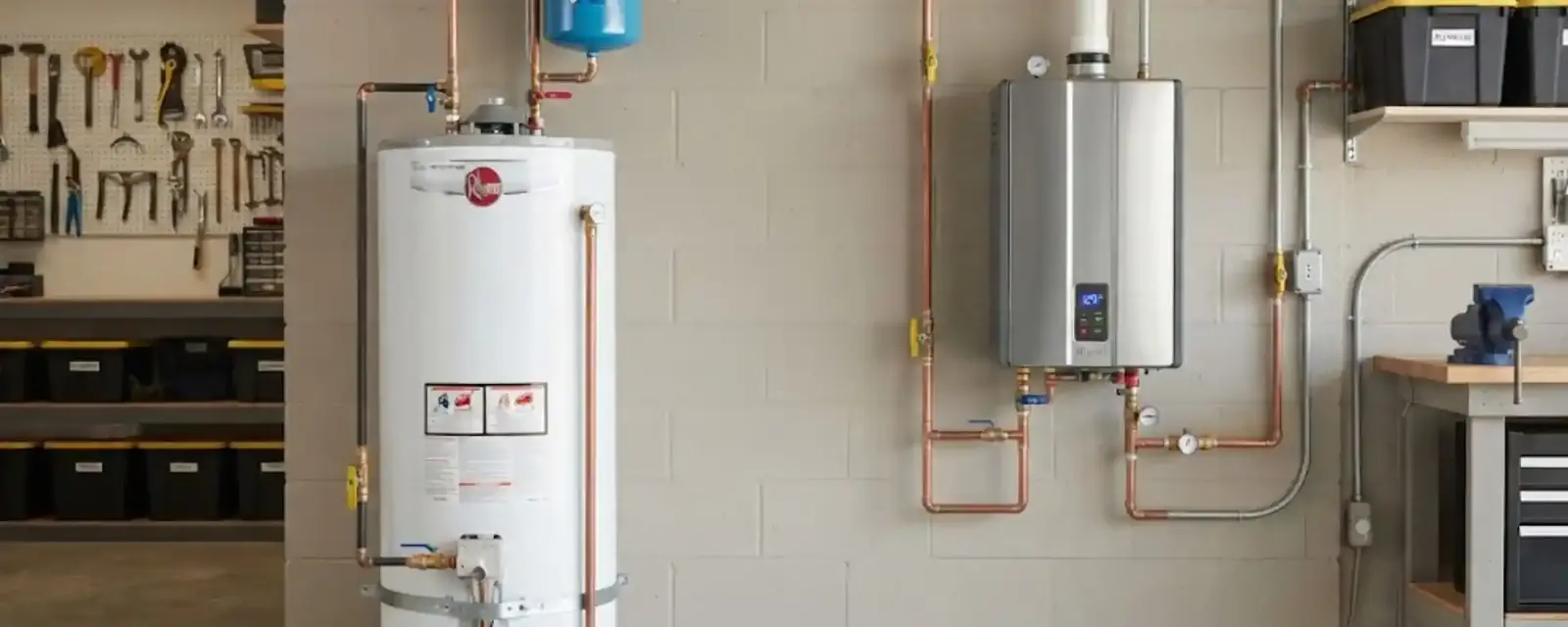
A tankless heater heats water only when you call for it, so it never runs out the way a tank can. It is not a one-size-fits-all upgrade, because the unit needs enough gas or electrical capacity and a compatible vent.
The plumber starts with a few questions about the house, then checks the gas meter and line, the vent route and how hot the water needs to be across several fixtures at once.
If your existing tank has failed and you need hot water now, see emergency water heater replacement for the quickest route back to a hot shower.
What the house has to supply
A tankless gas unit may call for a larger gas line than a tank heater uses, because it burns more fuel in a short time. An electric unit may need a heavy circuit that the panel cannot supply.
If the line or panel falls short, the upgrade can cost more than expected, and the plumber lays out those costs on the site visit.
Tank and tankless compared
Both work well when matched to the house.
| Feature | Tank | Tankless |
|---|---|---|
| Hot water supply | Limited to the tank volume | Continuous while the unit keeps up |
| Space | Takes floor space | Mounted on the wall |
| Install demands | Simpler vent and fuel | Larger gas or electric supply and special vent |
| Maintenance | Flush and check anode rod | Descale and clean filters |
Scale and well water
Tankless units have narrow passages, so mineral scale is a bigger deal than in a tank. The township's groundwater study found that private wells are common here, and well water can be hard or carry iron and sediment.
If your water leaves white crust on fixtures or stains from iron, the plumber may recommend a filter or softener first. Flushing the unit with a descaling solution on a regular schedule is part of owning one.
Service and flushing
Tankless service means cleaning the inlet filter, flushing the heat exchanger and checking the vent and condensate drain on condensing models. Error codes often point to a vent blockage, a flame sensor problem or scale.
For a failure, see emergency water heater repair, where the first visit is about diagnosing the cause.
Sizing by flow rate, not by gallons
A tank is sized in gallons, but a tankless unit is sized by how much water it can heat per minute at the rise you need. Cold incoming water in a Highlands winter is far colder than in summer, so the same unit delivers less hot water in January.
List the fixtures that run at the same time, such as a shower and a dishwasher, and the plumber adds up their flow to choose a unit that keeps up on the coldest days.
What affects the price of a tankless unit
The unit is only part of the cost.
Gas line or circuit upgrade
A bigger line or circuit is often needed.
Venting
Special vent materials and routes add cost.
Water quality
A filter or softener may be recommended first.
Unit capacity
Larger households need larger units.
Permit and inspection
Permitted work includes the inspection.
We give a clear price before work starts. The real number depends on your site, so call to arrange a look.
Tankless water heater questions
Will a tankless heater give endless hot water?
It heats continuously, but flow is limited by the unit's capacity. Several showers at once can exceed it.
Can I replace my tank with tankless in the same spot?
Often, with changes to the gas line, vent and water connections. The plumber checks on a site visit.
How often should a tankless heater be flushed?
It depends on water hardness and use. Hard or well water calls for more frequent flushing.
Do tankless heaters work with well water?
Yes, with attention to scale, sediment and iron. A filter is often part of the plan.
What does a tankless warranty cover?
Manufacturer terms vary. The plumber reviews the specific unit's terms with you.
What standard covers tankless installations?
The water and gas piping follow the National Standard Plumbing Code adopted in N.J.A.C. 5:23-3.15, the electrical supply follows the National Electrical Code (NEC), and the venting follows the manufacturer's instructions.